
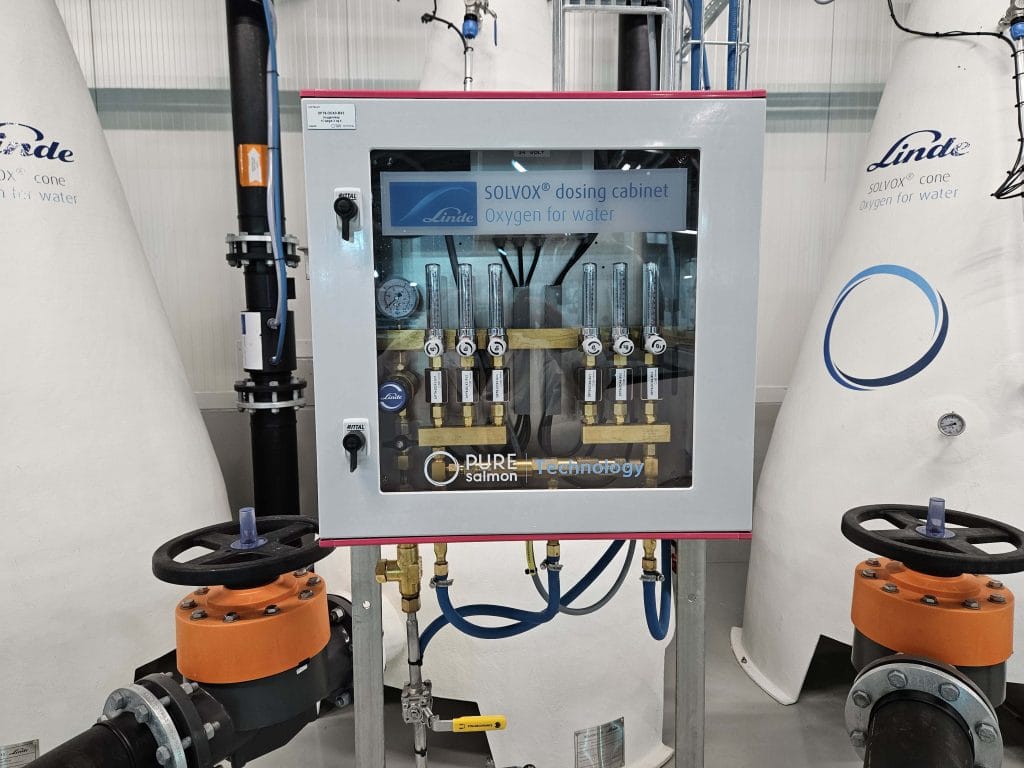
Gas balance in water is a critical factor in RAS operation. Small deviations can affect fish health and system stability.
What gases in water mean
Gases such as oxygen, nitrogen and carbon dioxide are dissolved in water. The amount depends on temperature, pressure and salinity. Water and air are constantly exchanging gases, but in RAS systems this balance is rarely stable.
Total gas pressure and saturation
Total Gas Pressure (TGP) is the sum of all dissolved gases. It reflects the overall gas load in the water. Gas saturation describes how much gas is dissolved compared to what is theoretically possible under given conditions. TGP above 100% indicates overpressure in the system and increases risk.
What affects gas levels
Gas levels in RAS are influenced by:
- pressure changes from pumps
- air entrainment in pipes and equipment
- water falls and turbulence
- oxygen addition and degassing efficiency
- biological activity from fish and bacteria
RAS systems are dynamic and rarely reach equilibrium. Gas conditions must be actively controlled.
Why it matters
Uncontrolled gas levels can lead to unstable operation and increased risk of fish health issues.
Gas management is not a single component, but a system-wide responsibility.
Key takeaway
Stable gas conditions depend on control of the entire system, not individual processes.